24 January 2021

A Drop in the Bucket: An Unconventional Switch


The circuit on the left and the switch on the right.


The switch uses a jar of coins to complete the circuit. The positive side of the circuit is buried in the jar. When a coin attached to the other side of the circuit touches one of the coins in the jar, the circuit completes and the red LED gets power and lights up. Since all of the coins are made of metal, they all conduct electricity and pass the current between each other. This is why the circuit completes itself despite the fact that the two coins that the wires are attached to are not touching each other. 

The schematic for the circuit.

And the video showing the switch in action.


23 January 2021

Unconventional Breakfast Switch - David Perez


Ensuring Connection, an Unconventional Switch.

The circuit with switch on right.

Greetings, the details, and creation of my switch are as follows: The circuit is powered by 4.7V from the circuit playground express processor into the breadboard. Then a 100 Ohm resistor transfers power from the input of power to one side of the switch. This is from using a simple red led, with a forward voltage of 2V and an ideal current of 20mA, the ideal resistor would be 135 Ohms. The switch utilizes the base of a sheath for an electric screwdriver, the bits of which are conductive. When the screwdriver bit is placed into the holder it completes the circuit by touching the two wires (one from the resistor the other connecting from the LED), turning the LED, and following the ground wire back to the supply.


The schematic for the switch.

Below is a quick narration of my switch and my idea behind creating it!


~JM


My unconventional switch utilizes a sword and its sheath. To start, a 9 volt battery is converted into 5 volts, then the current flows through a 220 ohm resistor. The current then travels down the wire into the sword, which transmits the current to the next wire into the LED. If the sword is not all the way in the sheath, then it loses contact with both of the wires, and the circuit is incomplete. Once the sword is put into the sheath, it most be put in all the way as the sword is wide near the hilt, thus making contact with the alligator wires and completing the circuit.

 For my unconventional switch, I decided to use a red LED, 330 ohms resistor, 9V battery and other materials needed such as red and black jumper wires and alligator clips to attach with the scissors and tin foil. The main objective for my switch was for my LED light to stay on when no contact was applied onto the tin foil and have the light turn off when the tin foil has contact applied to it. I wanted to resemble the clapper in my own way, but I'm not using my hands to clap to turn on the LED light.


22 January 2021

Here, we have a circuit that lights up when scissors come into contact with the tin foil you are trying to cut.

Have you ever struggled to cut tin foil with scissors before? Of course you have, everyone struggles with this exact issue at least once in their lifetimes. Well no more! This clever device aims to make guiding your scissors easier, by lighting up whenever it comes into contact with the piece of foil you intend to cut! Just watch this video demonstrating it's use:


Fascinating. And of course, is the schematic upon which this device was created:

21 January 2021

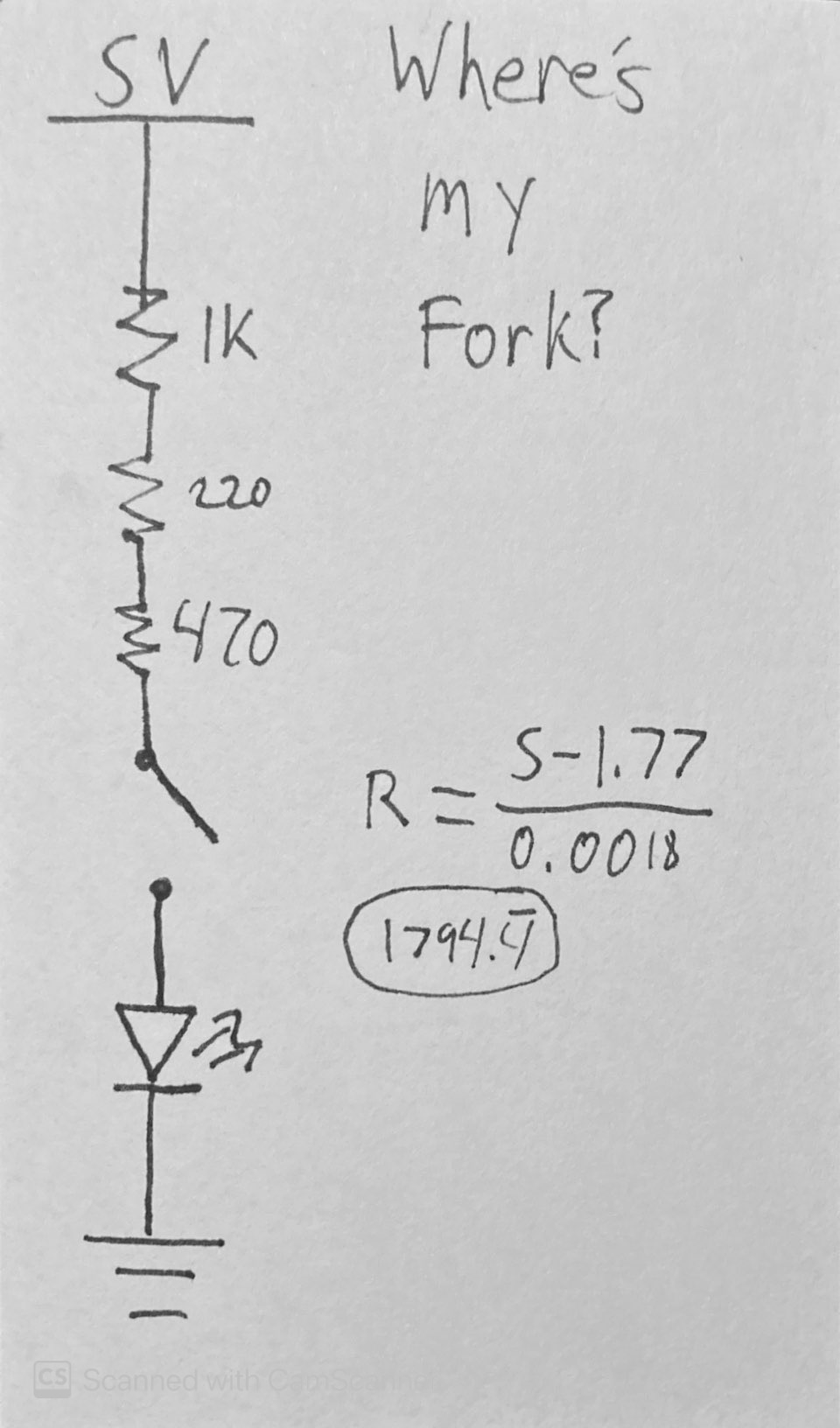
Scaffolding: Unconventional Switch - Where's my Fork?

     For my switch, I thought about how some people will bring food to the table and get comfortable only to realize that forgot their silverware. Since silverware is made of metal it was easy to create a circuit based around it. I also used a note card with a cut out of aluminum foil for conductivity to symbolize a dinner mat.

    For the circuit, I used a 5 volt power source provided by an Arduino Uno I had on hand, three resistors: 1K, 470, and 220, a red LED, an alligator clip to attach to the fork, and an alligator clip attached to the aluminum of the note card that attaches back to the ground of the Arduino to complete the circuit.


    A thought I had while making the switch is that if we were to expand the project, It would be interesting to create a dinner mat that can help people learn where certain pieces of silverware are supposed to go in a proper set up. Which would help those nervous about going to fancy dinner parties or those who want to train to be in the food service industry.