14 September 2024

Unconventional Switch - Electric Gloves

The Electric Gloves!

Aiden Richmond, Joey Linas


 The concept of this switch is the idea of creating and carrying an electric charge with just the clap of your hands. We used two rubber gloves and taped tinfoil to each one. One positive charge from the Arduino is attached to once glove, and the other glove is attached to a positive charge from the breadboard circuit. The initial voltage (Vi) from the USB-C is 5v, while the forward voltage (Vf) is 2v. Following the equation, we determined we needed two 100 resistors on the breadboard in order for the switch to work properly. As shown in the picture, our Arduino is grounded by the breadboard itself. Once the 2 gloves touch, the red LED illuminates until contact is not made anymore.




Unconventional Switch: Fork & Banana


Picture:


Video:


Hey everyone, our names are Jordan Oliver and Chelsea Soto. We wanted to create a switch for people who are visually impaired. This switch could be used to alert a person, when they grasp their food with their eating utensil. The materials we used to assemble our switch includes a circuit playground express, a red LED, a 100 ohm resistor, a fork, a banana, four alligator clips and a breadboard. First, we connected one end of the red and black alligator clips to the circuit playground express and the other end to the breadboard to provide its power supply. Finally, when we took the fork with the green alligator clipped to it and touched the banana with the blue alligator clipped to it, the red LED turned on.


Schematic:


13 September 2024

Unconventional Switch - Stapler

 Behold, the Stapler Switch!

Energized by a powerful 9 volt battery, This unconventional light switch lets you know when you're papers are stapled. Our original idea was to attach the alligator clips to both the hammer (positive) and the crimp area (ground). The stapler is conductive, but electrical tape was applied to the areas of contact to avoid clearance issues. 4 resistors were needed due to the power supply we used for the demonstration.


The switch is unique way of turning an LED on and off. Were this idea to be fully implemented, the wiring would be implemented within the stapler itself, to avoid any clearance issues that would could from external wiring.


Unconventional Switch - Dice Roll Light Indicator


For players of Monopoly, D&D, Scrabble, etc. This concept adds flair, excitement, and immersion to gameplay when rolling a die.

When rolling a die in a cup, and then setting the cup face up, the aluminum die will complete the circuit and trigger a light or chosen electronic to activate! The bottom of a Styrofoam cup is lined with copper tape, and a die is lined with aluminum foil. There are then two popsicle sticks on the inside of the cup at an angle to help the die hit the bottom. The switch then works by turning the green LED on as soon as the die touches the surface. 


12 September 2024

Unconventional Switch: Fly-Down Indicator


The Fly-Down Indicator is a clever invention which determines whether or not a person's zipper is undone. When the zipper is undone the indicator light is off, but when the zipper is up the indicator light turns on.

The circuit draws power from the Adafruit Circuit Playground Express, which is plugged into any traditional USB port, and onto the breadboard. The current then passes through a 100-ohm resistor. From there, the current travels to an alligator clip fastened towards the top of the right leg of the pants. The zipper itself forms an unconventional switch. When the zipper is down, there is no conductive material to receive the current, but when the zipper is up the alligator clip will make contact with the conductive head of the zipper. The head of the zipper is attached to yet another alligator clip which jumps back to the breadboard. Next, the current jumps to the red LED indicator. Finally, the current returns to ground on the breadboard and returns to ground on the Circuit Playground Express.


Schrödinger‘s Coin

Schrödinger’s Coin

This switch was designed with the “Schrödinger’s Cat” inquiry in mind. Except a cat doesn’t carry enough electricity in it to complete an electrical circuit. This could be a paperweight for the science nerds, it could just be an inside joke. The positive end of the battery is connected to an aluminum foil pad with an alligator clip. The negative end of the battery is connected to an LED, followed by a series of resistors. The resistors are connected to a second aluminum pad. The circuit is incomplete until a coin is placed on the two aluminum pad, connecting the two side of the circuit. 


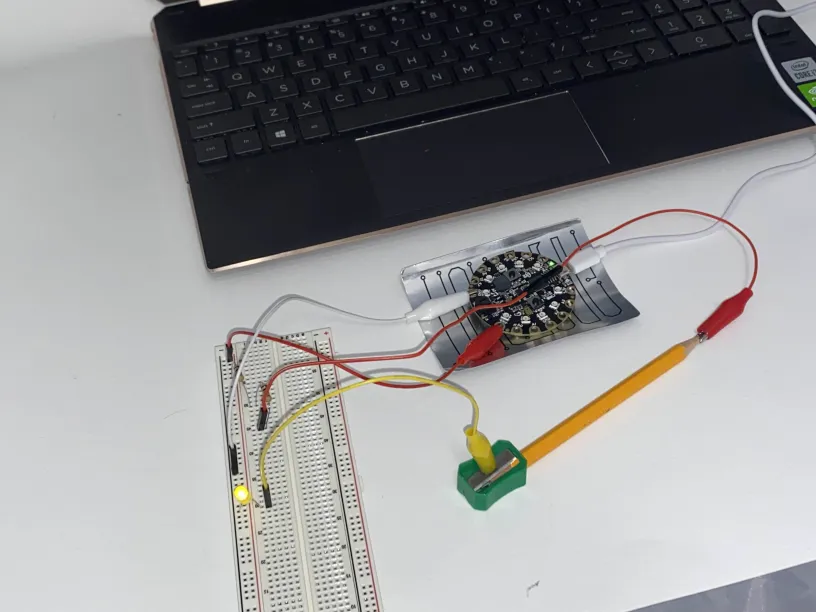
Unconventional Switch: Pencil Sharpener Light - by Thu Pham & Peter Ochoa


This switch design utilizes a pencil and pencil sharpener to create an unconventional, interactive way to control an LED. The 5V power source from the Circuit Playground flows through two 100-ohm resistors in series, creating a total resistance of 200 ohms, and powers a 2V yellow LED. The switch is formed by attaching one alligator clip to the pencil’s tip (graphite) and another to the metal sharpener. When the pencil is inserted into the sharpener, the graphite completes the circuit, causing the LED to light up. 

This design creatively explores the conductive properties of everyday materials like graphite and metal, turning a familiar object into a functional switch. Beyond a simple on-off mechanism, the concept embodies a playful interaction between user and object, transforming the act of sharpening a pencil into a moment of discovery and illumination. It also highlights the often-overlooked conductive potential of common materials, making the switch both functional and surprising.